When collectors have made counts of how many stamps have been issued, the sensible ones have limited themselves to totaling Regular Issues and Commemoratives. Using that approach, I come up with a little more than 60,000 regulars and commems released between 1840 and 1940. But when making my count, I had the bright idea of including everything in the 2007 Scott Classics Catalogue even though that added multiple layers of complexity as well as increased the opportunity for counting mistakes. With that in mind, when looking at all issues, I found that regular issues/commems account for about two-thirds of the stamps in the Catalogue. The other one-third are Back-of-the-Book (BOB).
Below is a table of my counts for the various stamp categories in the Scott catalog according to Scott's prefixes. These are sorted from the most stamps in a particular category to the least. Again, I caution you in placing too much faith in the exactness of the counts.
COUNT PREFIX DESCRIPTION
60,107 [No prefix] Regular issues, Commemoratives
5778 O/OX Officials, Post Office Seals
5248 J/JX Unpaid Postage
4885 C/CE/CO Airmail
4035 B/BK Semi-postals
3001 A*, AR Mandates, Plebescites, Provisionals, Postal-fiscal
1139 N Mandates
1113 R/RA/RAJ Revenues
1056 #L Local stamps
739 Q Parcel post, special handling
682 P Newspapers, periodicals
670 1N Occupation issues
614 U Envelopes
408 M Military
371 L Local
321 #X Provisionals (e.g., US or Confederate Postmaster Provisionals)
277 E Special Delivery
136 F Registration, Certified
62 Carrier Carrier
45 H Acknowledgment of Receipt
33 I Late Fee
32 G/GY Insured Letter, Marine Insurance
28 S Franchise stamps
18 D Pneumatic Post
18 K Offices Abroad
5 Y Revolutionary
90,821 TOTAL
When I started, I listed every prefix separately: for example, I initially separated Airmails from Airmail Special Deliveries, etc. This quickly became tiresome and so I went back and subsumed these all under a single prefix letter, in this case, C. Unfortunately, I shouldn't have done this for all categories. Mixing the various prefixes where A is the first letter intermixes the AR category which is cut from a different cloth than the others. I should have left that separate.
It should also note that the prefixes K, L, M, N, and Y can be used with any category. Consider the Military Stamps of Austria. There are regular Military issues, Military Semi-Postals, and Military Newspaper stamps. In my count all of these are included in the M count, not with the B or N counts.
Finally, some categories are deceptive. There are hundreds of Offices Abroad listed throughout the Catalogue but the only stamps assigned with the "official" K prefix are for UNITED STATES OFFICES IN CHINA Shanghai.
The last table breaks down the percentage for the most numerous prefixes. The most common type of BOB stamps are Officials--they constitute almost 19% of BOB issues. (Note that this is 19% of the thirty thousand BOB stamps, NOT 19% of the ninety thousand total stamps issued between 1840-1940.)
18.81% O/OX Officials, Post Office Seals
17.09% J/JX Unpaid Postage
15.90% C/CE/CO Airmail
13.14% B/BK Semi-postals
9.77% A*, AR Mandates, Plebescites, Provisionals, Postal-fiscal
3.71% N Mandates
3.62% R/RA/RAJ Revenues
3.44% #L Local stamps
2.41% Q Parcel post, special handling
2.22% P Newspapers, periodicals
2.18% 1N Occupation issues
2.00% U Envelopes
1.33% M Military
1.21% L Local
1.05% #X Provisionals (e.g., US or Confederate Postmaster Provisionals)
For the first two posts in this thread see: Part 1, Part 2.

The famous stamp collector Josiah Lilly said that there were 100,000 postage stamps he wanted for his collection and he succeeded in acquiring 77,000. My considerably easier target is 35,000 of the more common stamps from 1840-1940 contained in the Scott Blue International Album Volume 1. This blog will record my progress, provide general information about Classic era philately and hopefully encourage other "Blue" collectors.
Wednesday, May 5, 2010


Tuesday, May 4, 2010
The iPad and Stamp Collecting
I am an unabashed gadget geek. One example of this is that I have owned an iPad since the first day it was available for purchase. Since then I've found a couple of good uses for the iPad with my "Blue" collection which I would like to share.
I spend a lot of my time with my albums sitting on the couch rather than at a desk. This means I'm usually trying to balance an album, catalog, and laptop at the same time. Turns out for a couple of tasks, the iPad provides a viable alternative for the laptop, the catalog or both!
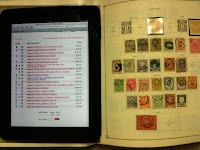
Off and on I will select a country that is largely complete and see what it would take to fill the remaining spaces. I usually start with the APS Stamp Store. I was happy to find that the iPad's screen size is fine for viewing this site in the Safari browser and it is easy to go back and forth between listings and zoomed views of the stamps. Most important is that the size and weight of the iPad vis-a-vis a laptop made this task much more convenient. I would expect other websites such as Zillions of Stamps to work equally well unless they use Flash to serve up their content or shopping carts.
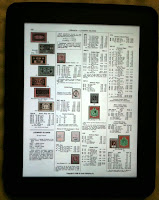
I own the last DVD version of the Scott Classics Catalogue. As you may know, the DVD contains the catalog in Adobe PDF format. I transferred the PDFs over to the iPad and viewed them using the GoodReader software. Although it is little bothersome to find the exact page you want, the overall convenience is hard to beat. It is especially nice if you find yourself refering between the website and the catalog.
Incidentally, this post was typed on the iPad but I had to add the images "manually."
I spend a lot of my time with my albums sitting on the couch rather than at a desk. This means I'm usually trying to balance an album, catalog, and laptop at the same time. Turns out for a couple of tasks, the iPad provides a viable alternative for the laptop, the catalog or both!
Off and on I will select a country that is largely complete and see what it would take to fill the remaining spaces. I usually start with the APS Stamp Store. I was happy to find that the iPad's screen size is fine for viewing this site in the Safari browser and it is easy to go back and forth between listings and zoomed views of the stamps. Most important is that the size and weight of the iPad vis-a-vis a laptop made this task much more convenient. I would expect other websites such as Zillions of Stamps to work equally well unless they use Flash to serve up their content or shopping carts.

I own the last DVD version of the Scott Classics Catalogue. As you may know, the DVD contains the catalog in Adobe PDF format. I transferred the PDFs over to the iPad and viewed them using the GoodReader software. Although it is little bothersome to find the exact page you want, the overall convenience is hard to beat. It is especially nice if you find yourself refering between the website and the catalog.

Incidentally, this post was typed on the iPad but I had to add the images "manually."
Tuesday, April 27, 2010
Miscellaneous Info on the Scott Internationals, etc.
I had a little time to visit the Wineburgh Philatelic Library at UT Dallas this weekend and tried to dig up some more information about the the history of the "Blue" International and its competitors. I'll be retroactively updating some of my earlier posts to reflect what I have found, but here is a summary.
First, I had assumed that there was a smooth transition between the two part "Blue" and the four part "Blue," but an October 1994 ad in Scott Monthly shows that a collector purchasing the set then would have bought three parts: Part 1A1 (US to Ethiopia), Part 1A2 (Falkland Islands-Latvia), and Part 1B (Lebanon-Zululand). My working supposition is that perhaps Part 1A went out of print before Part 1B. Later when Scott decided to reprint 1A, they split it into two parts. Now whether 1A1 and 1A2 represent the re-editing we find in the current 1A1 and 1A2, I do not know. Several years later, the 1998 Scott World Catalog lists 1A1, 1A2, 1B1, and 1B2, just as today.
An ad in the 1975 Scott Catalog gives a little more information on The Grand Award Album, which I assume Scott published to compete with the Minkus Master Global. Specifically, it had 1,300 pages and sold for $21.50.
I don't think I was aware that the original Brown albums in looseleaf form were printed on one side only, just like the Vintage Reproductions. (The bound volumes were double-sided.) The number of pages in the 19th Century volume was 732 and 1034 in the 20th Century Part 1 (i.e., 1900-1910).
Speaking of Vintage Reproductions, according to an ad in the 1996 Scott Classics Catalogue, their authorized copies of the Brown Internationals first included only 1840-1938 in 4540 pages. Another ad a year later shows that 1939-40 was available.
At one point in the late 1990s, Scott sold original stamp cuts from when their catalogs were still letterpress at $9.95 per cut. I wonder if these ever show up on eBay?
I confirmed from an ad that The Minkus Supreme Global did go from two to three volumes with the 1966 edition.
Although my lone hour at the Library meant that I was madly flipping through pages, I'm a little more skeptical now on how easy it is going to be to find some basic information that is still missing. I had assumed that Scott Monthly, the Scott Catalogs, and other publications would commonly have ads for the Internationals. Such ads seem to be much rarer than I had thought for significant periods of time.
First, I had assumed that there was a smooth transition between the two part "Blue" and the four part "Blue," but an October 1994 ad in Scott Monthly shows that a collector purchasing the set then would have bought three parts: Part 1A1 (US to Ethiopia), Part 1A2 (Falkland Islands-Latvia), and Part 1B (Lebanon-Zululand). My working supposition is that perhaps Part 1A went out of print before Part 1B. Later when Scott decided to reprint 1A, they split it into two parts. Now whether 1A1 and 1A2 represent the re-editing we find in the current 1A1 and 1A2, I do not know. Several years later, the 1998 Scott World Catalog lists 1A1, 1A2, 1B1, and 1B2, just as today.
An ad in the 1975 Scott Catalog gives a little more information on The Grand Award Album, which I assume Scott published to compete with the Minkus Master Global. Specifically, it had 1,300 pages and sold for $21.50.
I don't think I was aware that the original Brown albums in looseleaf form were printed on one side only, just like the Vintage Reproductions. (The bound volumes were double-sided.) The number of pages in the 19th Century volume was 732 and 1034 in the 20th Century Part 1 (i.e., 1900-1910).
Speaking of Vintage Reproductions, according to an ad in the 1996 Scott Classics Catalogue, their authorized copies of the Brown Internationals first included only 1840-1938 in 4540 pages. Another ad a year later shows that 1939-40 was available.
At one point in the late 1990s, Scott sold original stamp cuts from when their catalogs were still letterpress at $9.95 per cut. I wonder if these ever show up on eBay?
I confirmed from an ad that The Minkus Supreme Global did go from two to three volumes with the 1966 edition.
Although my lone hour at the Library meant that I was madly flipping through pages, I'm a little more skeptical now on how easy it is going to be to find some basic information that is still missing. I had assumed that Scott Monthly, the Scott Catalogs, and other publications would commonly have ads for the Internationals. Such ads seem to be much rarer than I had thought for significant periods of time.
Tuesday, April 20, 2010
How Many Stamps Were Issued Between 1840 and 1940? Part 2
When I was making my count of stamps in the 2007 Scott Classics catalog, I kept the totals in an Excel spreadsheet. Not to let this go to waste, I'm doing some sorts on the data that may be of interest.
Here are the top 25 countries ordered by number of stamps issued between 1840 and 1940. This count includes all of the various types of stamps in the Scott catalog, regardless of whether they are represented in the "Blue" International. Please do not place too much trust in the totals--for reasons outlined in the Part 1 of this post, I would expect these counts to be off by a percentage point or two.
2523 UNITED STATES
1656 COLOMBIA
1464 NICARAGUA
1409 HUNGARY
1296 TURKEY
1238 SPAIN
1197 MEXICO
1126 SALVADOR, EL
1034 IRAN
1027 AUSTRIA
996 RUSSIA
982 BELGIUM
957 ARGENTINE REPUBLIC
937 GERMANY
924 ROMANIA
865 URUGUAY
843 ITALY
817 ECUADOR
783 ALBANIA
764 BRAZIL
720 PORTUGAL
681 FRANCE
674 PARAGUAY
660 SWITZERLAND
636 GREECE
You may be surprised that Colombia ranks number 2 but remember all the hundreds of SCADTA airmails. To see whether there were any other "anomalies," I decided to run the sort again looking at only Regular Issues/Commemoratives. But while the rankings changed, most of the first group of countries were still in the second sort, just in a different order. Perhaps the surprise in the second list is the addition of Portuguese India with some 450 regular/commems.
UNITED STATES
IRAN
TURKEY
RUSSIA
MEXICO
SPAIN
NICARAGUA
PORTUGAL
SALVADOR, EL
HUNGARY
ROMANIA
URUGUAY
BRAZIL
GERMANY
COLOMBIA
ARGENTINE REPUBLIC
PHILIPPINES
PORTUGUESE INDIA
CHINA
GREECE
FRANCE
ECUADOR
ITALY
ARMENIA
AUSTRIA
It is harder to do a meaningful bottom group because most of the entries are along the lines of Yugoslavia's Carthinia Plebiscite. Nevertheless, here are the countries (as opposed to occupied areas, states, etc.) with the fewest stamps issued between 1840 and 1940:
3 IONIAN ISLANDS
4 FAROE ISLANDS
4 KIONGA
5 COCHIN-CHINA
6 STELLALAND
8 PITCAIRN ISLANDS
8 SASENO
9 ANNAM AND TONGKING
11 BARBUDA
11 NEW BRUNSWICK
11 PORTUGUESE AFRICA
For my next post, I'll look at whether there have been more postage dues than newspaper stamps and similar burning stamp collecting questions. I'm thinking that Pneumatic Post Stamps are going to rank pretty high. What about you?
Here are the top 25 countries ordered by number of stamps issued between 1840 and 1940. This count includes all of the various types of stamps in the Scott catalog, regardless of whether they are represented in the "Blue" International. Please do not place too much trust in the totals--for reasons outlined in the Part 1 of this post, I would expect these counts to be off by a percentage point or two.
2523 UNITED STATES
1656 COLOMBIA
1464 NICARAGUA
1409 HUNGARY
1296 TURKEY
1238 SPAIN
1197 MEXICO
1126 SALVADOR, EL
1034 IRAN
1027 AUSTRIA
996 RUSSIA
982 BELGIUM
957 ARGENTINE REPUBLIC
937 GERMANY
924 ROMANIA
865 URUGUAY
843 ITALY
817 ECUADOR
783 ALBANIA
764 BRAZIL
720 PORTUGAL
681 FRANCE
674 PARAGUAY
660 SWITZERLAND
636 GREECE
You may be surprised that Colombia ranks number 2 but remember all the hundreds of SCADTA airmails. To see whether there were any other "anomalies," I decided to run the sort again looking at only Regular Issues/Commemoratives. But while the rankings changed, most of the first group of countries were still in the second sort, just in a different order. Perhaps the surprise in the second list is the addition of Portuguese India with some 450 regular/commems.
UNITED STATES
IRAN
TURKEY
RUSSIA
MEXICO
SPAIN
NICARAGUA
PORTUGAL
SALVADOR, EL
HUNGARY
ROMANIA
URUGUAY
BRAZIL
GERMANY
COLOMBIA
ARGENTINE REPUBLIC
PHILIPPINES
PORTUGUESE INDIA
CHINA
GREECE
FRANCE
ECUADOR
ITALY
ARMENIA
AUSTRIA
It is harder to do a meaningful bottom group because most of the entries are along the lines of Yugoslavia's Carthinia Plebiscite. Nevertheless, here are the countries (as opposed to occupied areas, states, etc.) with the fewest stamps issued between 1840 and 1940:
3 IONIAN ISLANDS
4 FAROE ISLANDS
4 KIONGA
5 COCHIN-CHINA
6 STELLALAND
8 PITCAIRN ISLANDS
8 SASENO
9 ANNAM AND TONGKING
11 BARBUDA
11 NEW BRUNSWICK
11 PORTUGUESE AFRICA
For my next post, I'll look at whether there have been more postage dues than newspaper stamps and similar burning stamp collecting questions. I'm thinking that Pneumatic Post Stamps are going to rank pretty high. What about you?
Saturday, April 17, 2010
How Many Stamps Were Issued Between 1840 and 1940? Part 1
Seems like a reasonable question concerning this popular collecting area. And yet, as far as I can find on the Internet, no one has posted a count. Interestingly, there are estimates of the total number of stamps issued from 1840 until the present day. Michael Weatherford made a reasoned estimate of 600,000 or so by the end of the last century. But the total number of stamps issued is a perpetually moving target--surely, it should be easier to come up with a more exact number for the first one hundred years of philately? Well, yes and no. I've spent the last four months working on this off and on and here's what I've found.
To cut to the chase, there is not likely ever to be a definitive number. I don't know that this is a big deal as an approximate figure is probably good enough for most of us. But here is a list of the problems I've encountered in trying to count classic era stamps.
First, the catalog you pick will dictate the total. That is, every catalog, whether it is Scott, Gibbons, Yvert, et al, will list some stamps not in the others. I assume we aren't talking about a difference of many thousands for 1840-1940, but is still something to be aware of. For my count, I used the 2007 Classic Specialized Catalogue of Stamps & Covers. Even after choosing a catalog, the publishing date will make a difference. Scott has added hundreds of stamps in subsequent editions, although how many of them would have figured in my count is unclear.
Second, it is surprisingly difficult for some countries to obtain an accurate count at a glance, even for Regular/Commemorative stamps. For example, the numbering for country X may start at 1 and end at 100, but that doesn't mean there are 100 stamps. Catalogs are renumbered and some numbers previously used may be dropped. Or conversely, an issue might be given an intermediary designation to avoid a wholesale renumbering, so you could have both a 21 and 21A. Now, a careful person would compensate for all these anomalies, but I didn't take the time to do it. So there may be 100 stamps, or there could be 98 or 103. My hope is over the 500+ political entities involved that such differences will average out.
Third, some categories of stamps are not in a single numerical sequence. Here are a few examples of issues which required manual counts of a 100+ stamps: Confederate Postmaster Provisionals, Colombia SCADATA airmails, Ukraine Regional Issues (I did not count these), Stamps of Germany used in Cameroun, Canadian perforated Official Stamps, and United States Private Carriers--check these out and you'll see that one can't simply take the ending numbers but rather must do manual counts.
Fourth, for the British Commonwealth in particular, Scott includes issues to 1952. Where an individual stamp or set are clearly dated after 1940, these are easy to spot. But sometimes, stamps that don't belong in our count are intermixed within a set that contains some stamps issued in or before 1940 plus a few after. I didn't take the time to ferret out those few stamps that were issued after 1940 if the majority of the set was issued before. So my number for most British Commonwealth countries is likely overestimated by a few stamps.
So, what final count did I come up with? 91,000 stamps more or less. This means that the "Blue" contains about 40% of the stamps issued in the Classic Era and that are cataloged by Scott.
In Part 2 of this thread, I'll look at some interesting statistics, e.g., which countries issued the most stamps between 1840 and 1940 and what are the most common types of BOB stamps--i.e., were there more airmails or official stamps issued during this period?
UPDATE 6/2011: When I wrote this post I had not found any estimates for the number of classic era stamps. Today I came across the following on the website for the William J. Uihlein Collection: "Estimates vary, but one source declared that from 1840 to 1928 the world's governments had released about 57,000 regular issues of stamps, not counting minor varieties or revenue stamps." I have no idea what that source is but the number certainly seems plausible.
To cut to the chase, there is not likely ever to be a definitive number. I don't know that this is a big deal as an approximate figure is probably good enough for most of us. But here is a list of the problems I've encountered in trying to count classic era stamps.
First, the catalog you pick will dictate the total. That is, every catalog, whether it is Scott, Gibbons, Yvert, et al, will list some stamps not in the others. I assume we aren't talking about a difference of many thousands for 1840-1940, but is still something to be aware of. For my count, I used the 2007 Classic Specialized Catalogue of Stamps & Covers. Even after choosing a catalog, the publishing date will make a difference. Scott has added hundreds of stamps in subsequent editions, although how many of them would have figured in my count is unclear.
Second, it is surprisingly difficult for some countries to obtain an accurate count at a glance, even for Regular/Commemorative stamps. For example, the numbering for country X may start at 1 and end at 100, but that doesn't mean there are 100 stamps. Catalogs are renumbered and some numbers previously used may be dropped. Or conversely, an issue might be given an intermediary designation to avoid a wholesale renumbering, so you could have both a 21 and 21A. Now, a careful person would compensate for all these anomalies, but I didn't take the time to do it. So there may be 100 stamps, or there could be 98 or 103. My hope is over the 500+ political entities involved that such differences will average out.
Third, some categories of stamps are not in a single numerical sequence. Here are a few examples of issues which required manual counts of a 100+ stamps: Confederate Postmaster Provisionals, Colombia SCADATA airmails, Ukraine Regional Issues (I did not count these), Stamps of Germany used in Cameroun, Canadian perforated Official Stamps, and United States Private Carriers--check these out and you'll see that one can't simply take the ending numbers but rather must do manual counts.
Fourth, for the British Commonwealth in particular, Scott includes issues to 1952. Where an individual stamp or set are clearly dated after 1940, these are easy to spot. But sometimes, stamps that don't belong in our count are intermixed within a set that contains some stamps issued in or before 1940 plus a few after. I didn't take the time to ferret out those few stamps that were issued after 1940 if the majority of the set was issued before. So my number for most British Commonwealth countries is likely overestimated by a few stamps.
So, what final count did I come up with? 91,000 stamps more or less. This means that the "Blue" contains about 40% of the stamps issued in the Classic Era and that are cataloged by Scott.
In Part 2 of this thread, I'll look at some interesting statistics, e.g., which countries issued the most stamps between 1840 and 1940 and what are the most common types of BOB stamps--i.e., were there more airmails or official stamps issued during this period?
UPDATE 6/2011: When I wrote this post I had not found any estimates for the number of classic era stamps. Today I came across the following on the website for the William J. Uihlein Collection: "Estimates vary, but one source declared that from 1840 to 1928 the world's governments had released about 57,000 regular issues of stamps, not counting minor varieties or revenue stamps." I have no idea what that source is but the number certainly seems plausible.
Friday, April 9, 2010
Differences between the Scott International Junior and the Current "Blue"
A reader emailed me the other day asking about the differences between the "Blue" Volume 1 that Scott currently sells in four parts and the International Junior, which I took to mean one of the earlier single part editions. This is a question that much interests me and I thought I might try to summarize what I've found out so far.
By way of introduction, the editions of the "Blue" between 1943 and 1969 were sold in one part. Beginning in the 1970s, Scott split Volume 1 into two parts and most recently into four.
Number of Countries
There are more countries in the 1943 or 1947 editions than in any of the later volumes. The two part "Blue" editions are missing the most countries. Some of those countries in the 1943/47 editions were restored in the four part version but not all. For a complete list, click here.
Number of Stamps
The 1943/47 editions have spaces for the most stamps. Hundreds of stamps were unceremoniously dropped when Scott created the two part version which offers the worst coverage. However, there are stamps in the later versions that weren't in the 1943/47 editions.
Compatibility
The single part volumes are the least compatible with later volumes in the International series, the four part, the most. The single part volumes will have some countries that begin on the reverse of pages as well as multiple countries on a single page, making it impossible to seamlessly integrate the pages in Volume 1 with those in Volume 2 and later. This also means that countries are in a single alphabetical sequence in the latest editions.
Expandability
As in the "compatibility" category, the four part edition is the most expandable. In the four part version, all countries are their own units and the different classes of stamps (i.e., regular issues/commems, airmails, etc.) within a country are graced with their own pages. This arrangement makes it easier for collectors to create their own pages within or at the end of a country. Two byproducts of the four part arrangement are 1) there are many blank back (verso) pages in the four part version that can be used for mounting additional stamps, and 2) there also tends to be fewer stamps on many pages, leaving the collector room to make his or her own additions--perhaps those that were dropped from earlier editions--without necessarily having to add new pages.
Paper
The four part version is on thicker paper than any of the one part editions (I haven't physically examined a two part "Blue") and I suspect the paper may be of more archival quality. There is some variation in the paper thickness in the one part editions I've seen, but as albums can sometimes have collector-added replacement pages from other editions, I don't feel certain as to the state each edition was originally published.
Miscellanea
While probably not a big deal for most collectors, the earlier editions of the "Blue" had spaces at the top of the page for a portrait of the ruler and coats of arms as well as some gazetteer information. (Actually, I wish the latter were still in there.)
Cost
The single volume versions, usually the 1943 or 1947 editions, appear weekly on eBay and you might be able to score one with few or any stamps for as little as $50 or so. New copies of the four part version will set you back $400+ from Amos Advantage or another dealer. Now whether it is worth the $400 to have some of the advantages of the four-parter is up to the individual collector. If you do buy an earlier volume, note that these may not be complete (not infrequently the US pages are missing), there may be hinge remnants, tears, etc., and you probably want to make certain the edition is loose-leaf rather than hard bound.
Have I left anything out?
By way of introduction, the editions of the "Blue" between 1943 and 1969 were sold in one part. Beginning in the 1970s, Scott split Volume 1 into two parts and most recently into four.
Number of Countries
There are more countries in the 1943 or 1947 editions than in any of the later volumes. The two part "Blue" editions are missing the most countries. Some of those countries in the 1943/47 editions were restored in the four part version but not all. For a complete list, click here.
Number of Stamps
The 1943/47 editions have spaces for the most stamps. Hundreds of stamps were unceremoniously dropped when Scott created the two part version which offers the worst coverage. However, there are stamps in the later versions that weren't in the 1943/47 editions.
Compatibility
The single part volumes are the least compatible with later volumes in the International series, the four part, the most. The single part volumes will have some countries that begin on the reverse of pages as well as multiple countries on a single page, making it impossible to seamlessly integrate the pages in Volume 1 with those in Volume 2 and later. This also means that countries are in a single alphabetical sequence in the latest editions.
Expandability
As in the "compatibility" category, the four part edition is the most expandable. In the four part version, all countries are their own units and the different classes of stamps (i.e., regular issues/commems, airmails, etc.) within a country are graced with their own pages. This arrangement makes it easier for collectors to create their own pages within or at the end of a country. Two byproducts of the four part arrangement are 1) there are many blank back (verso) pages in the four part version that can be used for mounting additional stamps, and 2) there also tends to be fewer stamps on many pages, leaving the collector room to make his or her own additions--perhaps those that were dropped from earlier editions--without necessarily having to add new pages.
Paper
The four part version is on thicker paper than any of the one part editions (I haven't physically examined a two part "Blue") and I suspect the paper may be of more archival quality. There is some variation in the paper thickness in the one part editions I've seen, but as albums can sometimes have collector-added replacement pages from other editions, I don't feel certain as to the state each edition was originally published.
Miscellanea
While probably not a big deal for most collectors, the earlier editions of the "Blue" had spaces at the top of the page for a portrait of the ruler and coats of arms as well as some gazetteer information. (Actually, I wish the latter were still in there.)
Cost
The single volume versions, usually the 1943 or 1947 editions, appear weekly on eBay and you might be able to score one with few or any stamps for as little as $50 or so. New copies of the four part version will set you back $400+ from Amos Advantage or another dealer. Now whether it is worth the $400 to have some of the advantages of the four-parter is up to the individual collector. If you do buy an earlier volume, note that these may not be complete (not infrequently the US pages are missing), there may be hinge remnants, tears, etc., and you probably want to make certain the edition is loose-leaf rather than hard bound.
Have I left anything out?
Sunday, March 21, 2010
Lawrence Block on "The Abiding Patience of Stamps"
As usual, the latest Lawrence Block column in the 3/22/10 Linn's resonates. This time he is discussing how actively one has to be engaged to enjoy stamp collecting.
You will sometimes see the statement, "Sharks Need to Continuously Swim to Live" applied to stamp collecting. In other words, if your collection isn't growing, what's the point?
What the analogy misses, and Block's column documents in a variety of ways, is that stamp collecting doesn't demand daily involvement to still be a satisfying hobby. It is possible not to feed your collection for days, months, or perhaps even years at a time, knowing that it will still be there when you are ready. For some reason, I'm reminded of the "Nike" commercial from the movie What Women Want. The commercial within the film was about running, but if we switch to a collecting motif, then you might have
"And you can call on the [collection] whenever you feel like it...The only thing the [collection] cares about, is that you pay it a visit once in a while."
There have been several recent threads in discussion groups from collectors thinking about cutting back. The reasons vary but often include that all of the items still missing from their collection are too expensive to acquire. This is not a problem I expect to have with a Classic Era collection built around the "Blue" International. I own in another album what is likely the most expensive stamp in Volume 1 and I've already found the stamp that supposedly is the most difficult to acquire. So I can forge ahead, confident there is a reasonable chance that the last stamp I hinge in the album could come in at under a dollar.
(For accuracy, I should add that the need to continuously swim is only true for some varieties of shark.)
You will sometimes see the statement, "Sharks Need to Continuously Swim to Live" applied to stamp collecting. In other words, if your collection isn't growing, what's the point?
What the analogy misses, and Block's column documents in a variety of ways, is that stamp collecting doesn't demand daily involvement to still be a satisfying hobby. It is possible not to feed your collection for days, months, or perhaps even years at a time, knowing that it will still be there when you are ready. For some reason, I'm reminded of the "Nike" commercial from the movie What Women Want. The commercial within the film was about running, but if we switch to a collecting motif, then you might have
"And you can call on the [collection] whenever you feel like it...The only thing the [collection] cares about, is that you pay it a visit once in a while."
There have been several recent threads in discussion groups from collectors thinking about cutting back. The reasons vary but often include that all of the items still missing from their collection are too expensive to acquire. This is not a problem I expect to have with a Classic Era collection built around the "Blue" International. I own in another album what is likely the most expensive stamp in Volume 1 and I've already found the stamp that supposedly is the most difficult to acquire. So I can forge ahead, confident there is a reasonable chance that the last stamp I hinge in the album could come in at under a dollar.
(For accuracy, I should add that the need to continuously swim is only true for some varieties of shark.)
Subscribe to:
Posts (Atom)